
AI can now produce personas, research summaries and prototypes that look finished in minutes. That makes it easy for a team to build on something nobody has checked. Here's the order I work in, and the test I use between each stage to catch it.
Looking done is free now
AI can draft a persona in a minute. A journey map, a research summary or a clickable prototype arrives looking polished and complete. A few years ago, the effort it took to make those things was a rough signal that someone had done the thinking behind them. That signal's gone. Researchers at Stanford and BetterUp found that 40% of US desk workers had received what they call "workslop" in the past month, meaning AI-generated work that looks finished but has little real substance.
Often the output is good. The trouble is that it's just as convincing when it's wrong, and that's the hardest kind of mistake to catch. I've written before that AI rarely fails loudly; it fails plausibly. In a piece on speed, I argued that AI made production far cheaper while validation stayed about as expensive as it always was.
Put those together and you get a new failure mode. A team can now move from idea to polished artifact without ever deciding what it actually knows. Every step looks finished, so nobody stops to ask whether it's true.
The industry is starting to name this. Nielsen Norman Group called 2026 the year of AI fatigue and warned against "design theater," going through the motions without getting results. A review of a dozen peer-reviewed studies on AI-simulated research participants found them too imprecise to rely on for critical decisions. The speed isn't going away, and it shouldn't. The job now is to keep it without skipping the checks.
When looking right costs nothing, a team needs a deliberate way to decide what it knows. What follows is mine, built from methods I've combined and adapted over more than twenty-five years in design, and rebuilt for working with AI. Market Inward is the playbook, the order the work happens in. Reality Wins is the test between each step.
Start with the market, not the feature
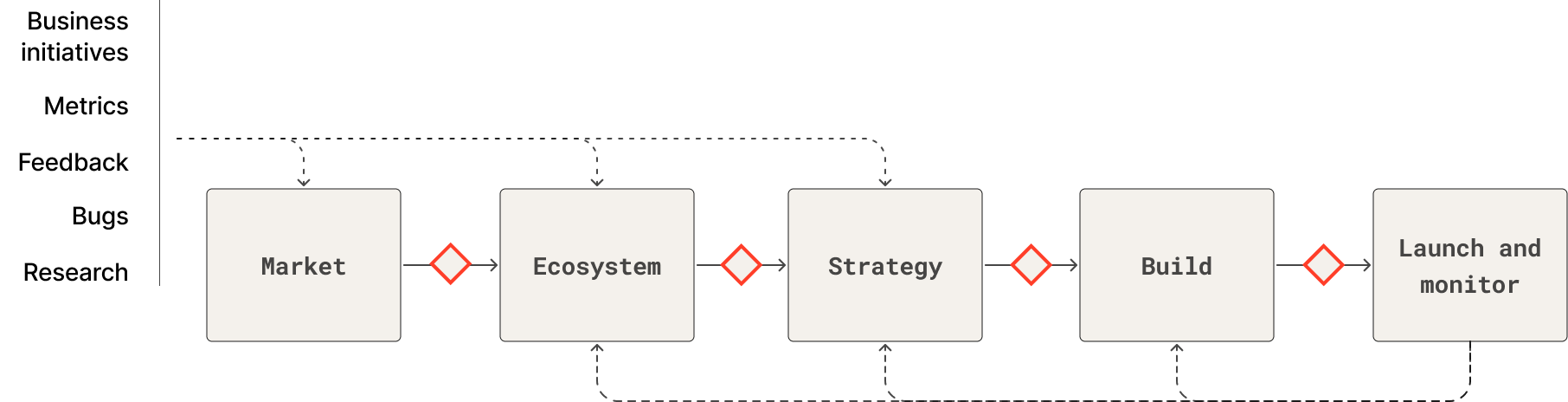
Market Inward starts with the market and the people in it. Who pays, who uses, and what success looks like for them at three, six and twelve months. Then the ecosystem around the product, meaning the other tools, institutions, rules and relationships it has to live inside. After that come strategy, build, and finally launch and monitoring.
The alternative is what I'd call feature outward. A team starts from what it wants to build and works backward to find the reasons. It's common because it feels productive, and there's something to show on day one. But every decision after that inherits an assumption nobody tested. The cost shows up late, usually in build, when changing course is most expensive.
The order isn't a fixed ritual. Each stage exists so the next decision has something to stand on. You can't set strategy for a market you haven't described, and you can't build well for an ecosystem you haven't mapped.
The structure is defined, the path through it isn't.
Real projects rarely start at the beginning. Some come in as a business initiative. Some start from research or customer feedback, a question about the metrics, or a bug that turns out to be a symptom of something bigger. Wherever a project comes in, it passes through strategy before anything gets built, even if only briefly for a small fix. Monitoring after launch feeds back into definition and design, so the process loops. Brand and marketing run alongside the product work, not after it or apart from it.
That means no two projects move through it the same way. Where a project starts, which stages get the most time and how many times it loops back are all set by the client, project, and/or the problem. A small team with one narrow question might spend nearly all its time in two stages. A platform rebuild might go through all five, more than once.
That flexibility only works because the five stages stay the same on every project. Without a fixed set, the process gets made up as the team goes. Each project invents its own order, and later nobody can tell whether a step was skipped on purpose or just forgotten.
What makes looping back safe is the documentation. Every stage leaves a written record of what was learned and decided, and that record becomes the context AI works from in later stages. When a loop turns up something new, it updates the record it touches, the ecosystem map for example, and every stage that draws on that record benefits. A project can go back without starting over, and each pass starts from more than the last one did. The gate decides what goes into the record, so a guess doesn't get written down as a finding and carried forward.
The gate between stages
Reality Wins is the test between those stages. Before work moves forward, it has to answer three questions:
- What do we know?
- How do we know it?
- What would change our mind?
The third question is the one teams skip, and it matters most. If nothing could change your mind, you don't have a finding. You have a position.
So before the research runs, the team decides what result would count as support and what would count against. Writing that down in advance keeps a team from reading whatever comes back as confirmation. Scientists call this pre-registration. You decide what would count before you look, so the results can't quietly redefine success.
Here's a made-up but typical example of what a gate records.
We believed: small-business owners want to approve every payment their bookkeeper schedules.
We'd change our mind if: fewer than half of the owners we talk to approve payments themselves today.
We found: two of eight did. The rest trusted their bookkeeper and wanted a weekly summary instead.
Decision: cut per-payment approval and build the weekly summary.
Sometimes the evidence isn't there yet and waiting isn't an option. There's a deadline, a partner commitment or a funding round. The decision still gets made, but it's labeled as made in ambiguity. It gets an owner, and a trigger that would send it back for another look. Every method calls itself evidence-based. Far fewer admit that some calls get made on judgment, before the evidence exists, and fewer still make you say which ones. Assumption mapping, from the Lean UX world, comes close, because it lists the beliefs a team hasn't tested yet. This goes a step further and tracks the decisions already made on those beliefs, each with an owner and a trigger to revisit it.
Because each stage's work is framed as a hypothesis, the gate is as likely to say "don't build this" as "build this." When the evidence says a feature isn't worth building, cutting it is a real result. Learning that at a gate is far cheaper than learning it after months of building.
If you've worked with Stage-Gate or Lean Startup, some of this will look familiar, because I've borrowed from both. From Stage-Gate, the idea that a gate is where a team commits, not just where it reports progress. From Lean Startup, the idea that a plan is a set of hypotheses waiting to be tested.
The differences are in what the gate checks and when learning happens. In a lot of organizations, stage gates drift into checking that deliverables are done. Here, work moves forward when there's enough evidence for the next decision, not when an artifact is finished. Lean Startup learns by building, shipping and measuring, which is powerful when shipping is cheap. In products that move money, shipping to learn is often expensive or not allowed, so research and building run side by side, and evidence can arrive before anything gets built. And every claim carries a label for how well it's supported, and that confidence can't go up without new evidence.
The gate rules are still evolving. What I've described is what a gate asks, not a formula for scoring it. I'd be wary of anyone who claims to have that formula, because how much evidence is enough depends on the decision. A button label you can change tomorrow doesn't need the proof that a change to how money moves does. A single fixed threshold treats those two the same, and it gives a team a number to hit instead of a question to answer.
Where AI fits
AI widens what this process can attempt. It can synthesize more interviews, scan more of a market and explore more options before a team commits to one. Work that used to take a quarter can fit in a few weeks.
More output means more for the gate to check, so research and documentation follow a three-part division of labor, with a person in the loop. One AI model does the generating, producing drafts, syntheses and options. A second, different model reviews that work and looks for problems, such as claims the evidence doesn't back up, sources that don't say what they're quoted as saying, and conclusions that go further than the data. Then a person makes the call. Two models agreeing doesn't prove much on its own. They learned from a lot of the same material, so their agreement is often one source echoed twice. One 2025 study found that when two models are both wrong, they pick the same wrong answer about 60% of the time, far more often than chance would predict.
The documentation described earlier is also what keeps the AI work honest. It's written as the work happens, in plain files anyone can open, usually markdown, and every decision is logged with the evidence behind it. Months later, anyone can trace why something was built, or why it wasn't.
Most of the industry now agrees that AI output is only as good as the context it's given, so teams are feeding it more personas, research and past decisions. That helps, but context can be wrong too, and AI builds on a wrong record as confidently as a right one. The gate is quality control for what the AI learns from.
AI informs judgment. It doesn't replace it. And it usually can't settle a question about users. It can widen research, but only contact with real people settles anything, a point I've made at more length in a piece on AI and user research.
What's actually new
Most of the parts are borrowed, and I've said from where. Three aren't, and each one answers a way AI work fails that older methods weren't built for:
- Agreement between AI models isn't evidence. Models trained on similar material make the same mistakes, so one generates, a different one audits, and a person decides.
- Confidence only goes up with new evidence. Every claim carries a label for how well it's supported, so a "may" can't quietly turn into an "is" as summaries get summarized.
- The record AI learns from gets checked too. The industry's answer to weak AI output is more context. This adds a gate on what goes into that context, so a guess doesn't become a fact that every later stage builds on.
How the method got here
This method didn't start on a whiteboard. It grew out of years of creative direction, then product design, hands-on AI experimentation, and then this year's work on an unreleased product for independent financial advisors and bespoke apps for a commerce client.
The first move was to check whether a concept I'd first pursued around 2016 still had a market. It largely didn't. Others had met that need in the years since. So the method's first result was not to build the old idea, and to look for the openings that were left instead. That's the "don't build" outcome in practice, and it saved months. It's the check I wish we'd run back in the day.
From there, a body of discovery work built with one model was audited by another, then tested with real users in two rounds of unmoderated research. The stop criteria were set before the research ran. When it ended, I knew the results counted because I'd decided in advance what would count.
The second moment was smaller and more telling. Between two documents, a claim drifted from "advisor value may be invisible" to "advisor value is invisible." No new evidence had come in. The wording had just hardened as it was carried forward, and the review caught it. That kind of drift is exactly what AI makes easy, because a model summarizing a summary has no particular reason to keep the "may."
What changed was that the gate stopped being a habit and became a rule. The method is in active use and still changing. I'll write up the build and launch stages as that work happens.
What it changes for a team
I think the gains are concrete. There are fewer reversals late in build, because the expensive assumptions got tested early. Decisions can be traced, so a new hire or a new executive doesn't have to relitigate why something exists. Design and engineering argue from the same evidence instead of from taste on one side and feasibility on the other. And ambiguity becomes visible, labeled and owned, instead of buried inside a confident-looking deck.
None of this is meant to slow a team down. What it aims to do is make it much harder to be confidently wrong.
That's the whole idea behind the name. Reality gets the final say, and the process is built so it can.
References
Speed isn't the problem. Unvalidated speed is. (ASID Insights)
AI doesn't lower the bar for product design. It raises it. (ASID Insights)
Move fast on the build. Never on the understanding. (ASID Insights)
Your design system can only express decisions you already made. (ASID Insights)
AI Can Ask the Questions. It Can't Tell You What the Answers Mean. (erictomlinson.com)
State of UX in 2026 (Nielsen Norman Group)
AI "workslop" sabotages productivity, study finds (Axios, on the Stanford and BetterUp research)
A Review of Experiments with Synthetic Users (MeasuringU, April 2026)
Correlated Errors in Large Language Models (Kim, Garg, Peng and Garg, 2025)